No. 027 of 217
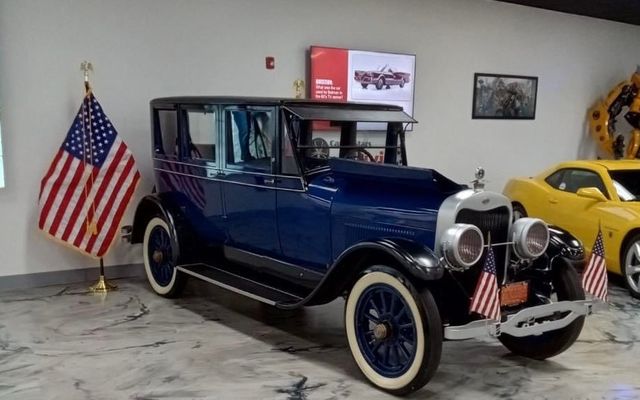
The LaSalle was the "companion" car to the Cadillac, launched in 1927 and remained in production until 1940.
Individual body styles at La Salle, the great stylistic adventure of General Motors, had their own in-house nomenclature in 1930. The overall LaSalle line was designated as the Series 340 that year, and the physically largest one was the seven-passenger touring car, or the Fleetland. Buyers had their choice of 13 Fisher or Fleetwood bodies for the 1930 LaSalle and with overall production of 14,986, they were atypical even when new.
All of the models rode on 134-inch wheelbases, six inches less than their corresponding Cadillac brethren, with power from the 90-degree, 340 cubic inch L-head V-8 that had powered the 1928 and 1929 Cadillacs, rated at 90hp. La Salle produced 239 1930 Fleetland and the cost new was $2,525.
The first engine upgrade to the LaSalle was introduced in 1929 with the Series 328, which had slight differences to the Cadillac V8 which was also upgraded. The Victoria and business coupe were replaced with the Landau Cabriolet from Fisher while Fleetwood choices were all cabriolet coupes or sedans. Both wheelbase choices were both available for Fisher and Fleetwood coachwork selections. September 1929 is when Cadillac introduced its all-new 1930 Series 353, one month before the Cadillac V-12 and the Wall Street Crash of 1929.
The ultra-luxury Cadillac V-16 made its grand introduction January 1930, and the LaSalle received another engine upgrade introduced in the LaSalle Series 340. Fisher body selections were reduced to seven closed while Fleetwood choices expanded to six. The only wheelbase used was 134" and a radio was first introduced as an optional item for US$175 ($3,192 in 2023 dollars) and all LaSalle's were prewired with an antenna imbedded in the roof. Wheels were available in hickory artillery style, wire wheels or solid pressed steel discs. The engine displacement of the 1930 LaSalle and the 1928-1929 Cadillac Series 341 were essentially identical so the LaSalle was labeled as Series 340 while the 1930 Cadillac V8 was upgraded to Series 353. In an attempt to further add exclusivity, Fleetwood convertible coachwork selections were further distinguished by the descriptions "Fleetcliffe", "Fleetlands", "Fleetway" and "Fleetwind" which didn't continue for 1931. The next vehicle choice offered by GM was the all-new Buick Series 50 coupe or sedan with a straight-eight engine with a similar appearance and a Fisher Body for US$1,540 ($28,088 in 2023 dollars) while a LaSalle Series 340 sedan was listed at US$2,565 ($46,783 in 2023 dollars
General Motors chairman Alfred P. Sloan had been considering a new vehicle range to fill the ever-growing gap between Buick and Cadillac since about 1920, but it wasn’t until 1924 when Cadillac’s president Lawrence Fisher finally put that plan into motion. A key move from Fisher was to hire a talented young designer named Harley Earl to style this new car, called LaSalle. The son of a California coachbuilder, Earl was assigned the task of designing a stylish new motorcar that would convey the elegance and status of Cadillac, but with a more sporting, agile appeal, and at a more affordable price point. Earl would later reveal his original design for LaSalle was influenced by Hispano Suiza, particularly in the graceful fenders and distinct, high peaked radiator grille. LaSalle’s bold two-tone color schemes however, were all Harley Earl.
Mechanically, LaSalle utilized its own V8 engine that was similar to Cadillac’s unit albeit smaller and with a few fundamental differences. By 1930, however, LaSalle’s V8 was in essence the same size and output as the Cadillac’s, imparting the lighter LaSalle with a sporty, agile feel. It seemed that GM came along with the idea for a junior Cadillac brand at just the right time. Given the economic crash of the late 1920s, the more affordable car sold exceptionally well in its first three years, often outselling its senior sibling handily. By the end of the 1930s, LaSalle had become a serious threat to Cadillac and was stealing sales from the flagship marque, and so it was given the axe in 1940, with the Cadillac Series 60 taking over the helm as the value leader. Perhaps more importantly, it was the first major success for Harley Earl; a man who would go on to become a legend within GM and earn his place as one of the most influential automobile designers in history.
This 1930 LaSalle Series 40 wears a rare and attractive 7-passenger
Fleetlands touring car body by Fleetwood. Just 239 examples of this Fleetwood style (catalog number 4057) were built, compared to more than 3,100 Town Sedans, making it quite rare today. With a well-preserved older restoration, this LaSalle is a great looking example that is well-suited for touring and regular enjoyment. In keeping with Harley Earl’s original design brief, this car is finished in a bold two-tone color scheme of silver over burgundy fenders and feature lines with subtle red striping. Paint quality is very good, showing a few minor touchups upon close inspection, but remaining very attractive overall. The body presents well with straight, properly aligned panels and clean reflections. It rides on a set of color-keyed disc wheels, with dual side mount spares giving the car a sporting and purposeful look. The brightwork shows in fine condition, and the body is well accessorized with a pair of steerable Pilot Ray driving lamps, a heron mascot (available on both Cadillac and LaSalle ranges), dual side mount spares with mirrors and a large painted metal trunk. Harley Earl’s styling of the fenders and grille combine with Fleetwood’s expertly judged body to produce a very handsome and sporty touring car.
Interior trim is very nicely presented in red antiqued leather to complement the exterior livery. Generously sized wind wings are mounted to the front screen, while rear passengers have their own windscreen with fold out wind wings and a clever sliding central panel that opens to allow them to converse with the driver. A pair of folding jump seats allows for two additional passengers, and of course the black canvas top can be folded for the full open-air motoring effect. The instrument panel is in good condition, with original dials supplemented with later-addition temperature and amp gauges to keep a watchful eye on underhood vitals.
The LaSalle V8 is nicely detailed and presented in mainly correct finishes, very suitable for a high-quality driver. The chassis and undercarriage are exceptionally clean and tidy, showing the car has enjoyed light and careful and use since its restoration. It runs and drives well, with the typical smooth power delivery and respectable performance for which LaSalle was so well known. This handsome and rare automobile is a fine example from this short-lived, but no less historically important marque; one that launched the career of Harley Earl, helped save Cadillac during the Great Depression, and inspired the likes of Packard and Lincoln to create their own entry level lines. With its handsome and rare Fleetwood coachwork and eye-catching presentation, this LaSalle Series 40 would make a fine choice for local shows and casual touring with family and friends.
Cadillac 90-degree V-8 engine
3-speed Syncro-Mesh transmission
Build date was 5/1/1930
Shipped to Glacier Park, Montana c/o Hall Cadillac, Denver
Rick DeBruhl Commentary - What the Heck is a LaSalle
Pre-War Classics / 1916–1941