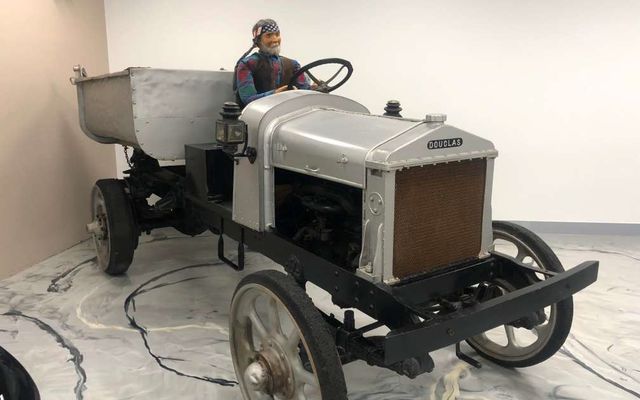
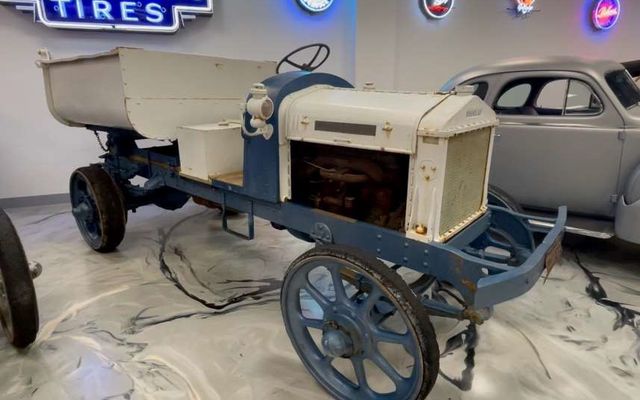
No. 004 of 217
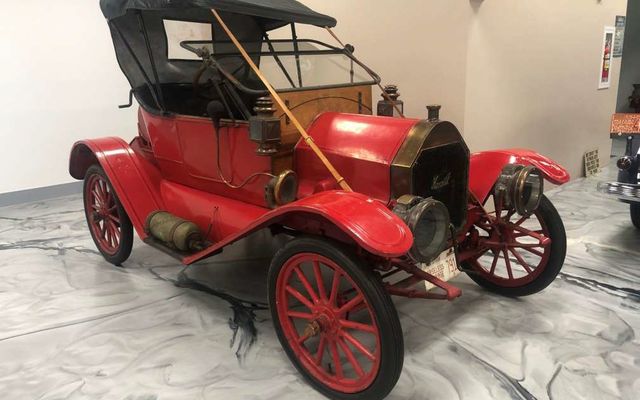
The 1910 Brush Runabout, produced by the Brush Runabout Company (originally the Brush Motor Car Company, 1907–1910), was a lightweight, two-passenger automobile designed by Alanson Partridge Brush in Highland Park, Michigan. Known as the “Everyman’s Car,” it was celebrated for its affordability and innovative design, targeting a broad market before the Ford Model T dominated the low-price segment. Below are key details about the 1910 Brush Runabout:
• Design and Features:
• Chassis and Construction: The 1910 Brush featured a wooden chassis with wooden rails and iron cross-members, using oak, hickory, or maple for the frame, axles, and wheels. This construction kept the car lightweight (around 800 lbs) and affordable, though it was considered both innovative and archaic, as noted in a 1907 Cycle and Automobile Trade Journal review.
• Engine: It was powered by a single-cylinder, four-stroke, water-cooled engine, initially rated at 6 horsepower (hp), though some sources note up to 10 hp for later models like the 1910 Model D. The engine ran clockwise to reduce the risk of injury during hand-cranking, though improper operation could still cause injuries like dislocated thumbs or broken forearms.
• Transmission: The car used a friction-drive transmission, providing variable speeds, described as offering “eight speeds forward and reverse” in some advertisements.
• Suspension: It had “underslung” coil springs in tension (not compression) on both sides of each axle, enhancing ride comfort compared to contemporaries.
• Lighting and Accessories: The vehicle featured two gas-powered headlamps and a rear lamp, with a horn connected to a squeeze bulb near the driver. A small storage drawer was accessible under the rear seat.
• Price and Variants: Priced at around $500 in 1910 (down from $780 in 1907), it was highly affordable. A “Gentleman’s Runabout” variant is noted, with one displayed at the Gilmore Car Museum in Hickory Corners, Michigan. A lower-priced Liberty-Brush model was introduced later (1911–1912) for $350, featuring simplified bicycle-style fenders.
• Notable Achievements:
• Glidden Tour (1909): Two Brush Runabouts participated in the 2,636-mile Glidden Tour, a grueling reliability run. Although neither completed the tour, their participation highlighted the car’s durability.
• Pikes Peak Climb (1908): While not specific to 1909, a 7-hp Brush Runabout climbed Pikes Peak in 1908, the third car to do so under its own power, showcasing its hill-climbing prowess, as advertised with the slogan, “a squirrel can climb a tree better than an elephant.”
• Preservation: A restored 1909 Brush Runabout is on display at the Linn County Historical Museum in Brownsville, Oregon, and a 1909 “Gentleman’s Runabout” is at the Gilmore Car Museum.
• Market Context: The 1909 Brush competed in a crowded market of small runabouts with one to four cylinders. Its lightweight design and low cost made it popular, but runabouts fell out of favor due to their lack of weather protection, especially as the Ford Model T gained dominance.
History of the United States Motor Company (USMC)
The United States Motor Company (USMC) was a short-lived automotive conglomerate formed to compete with General Motors. Below is a concise history based on available information:
• Formation (1910): Founded by Benjamin Briscoe, a financier and automotive entrepreneur, USMC was established in 1910 as a consolidation of several smaller automakers, including the Brush Runabout Company, Maxwell-Briscoe, Stoddard-Dayton, Columbia, Courier, Alden Sampson, and others. The goal was to create a powerful entity to rival General Motors by combining resources and streamlining production.
• Structure and Strategy: USMC aimed to produce a range of vehicles, from affordable runabouts like the Brush to higher-end models like Stoddard-Dayton. Maxwell-Briscoe was the largest and most successful component, producing reliable, mid-priced cars. The Brush Runabout Company, absorbed in 1910, continued to manufacture its lightweight cars under USMC, with some models like the Liberty-Brush introduced to boost sales. The conglomerate operated factories in multiple states, with Brush production remaining in Detroit, Michigan.
• Challenges: USMC faced significant hurdles:
• Financial Mismanagement: Briscoe’s aggressive expansion and heavy borrowing led to financial strain. The company struggled to integrate its diverse brands and achieve economies of scale.
• Market Competition: The rise of Ford’s Model T, with its mass production and affordability, overshadowed USMC’s offerings. Runabouts like the Brush were becoming obsolete due to their open design and limited practicality.
• Internal Conflicts: Disagreements among the merged companies’ leadership and inefficiencies in production coordination weakened USMC’s operations.
• Decline and Bankruptcy (1912–1913): By 1912, USMC was in financial distress and filed for bankruptcy. The conglomerate collapsed in 1913, ending production for most of its brands, including Brush. Maxwell-Briscoe survived the collapse, reorganizing as the Maxwell Motor Company, which later became part of Chrysler. The failure of USMC was attributed to fierce competition, poor financial planning, and the rapid shift in consumer preferences toward more modern vehicles.
• Legacy: Despite its failure, USMC represented an ambitious attempt to consolidate the fragmented early automotive industry. The Brush Runabout’s innovative design and affordability left a mark, with surviving examples preserved in museums. The collapse of USMC highlighted the challenges of competing in a rapidly evolving market dominated by innovators like Henry Ford.
Additional Notes
• Alanson P. Brush’s Role: Alanson Brush, a self-taught engineer, was a key figure in the Brush Runabout Company. Before founding the company in 1907, he worked with Henry Leland at Oldsmobile and helped design the single-cylinder Cadillac engine. His innovative approach is evident in the Brush’s lightweight construction and unique features, though his reliance on wooden components was seen as outdated by some contemporaries.
• Cultural Impact: The Brush Runabout gained publicity through feats like the 1912 trans-Australian trip by Sid Ferguson and Francis Birtles and the 1910 Abernathy Boys’ cross-country journey, which the company leveraged in advertisements.
Key Features:
• Glass tube: Allows the driver to visually monitor oil flow.
• Adjustable needle valve: Lets the driver regulate how much oil is dispensed.
• Manual plunger or feed control: Sometimes operated by hand or spring-loaded.
• Purpose: It directed small amounts of oil to key components like the engine or transmission via gravity or low pressure. In early vehicles, centralized lubrication systems were rare, so these were a vital part of keeping the car running.
In the Brush, which had a unique wooden chassis and a relatively simple one-cylinder engine, proper lubrication was essential — and manually monitored and controlled systems like this were typical.
The Brass Era / 1886–1915