No. 069 of 217
Tom and Gayle Broadbent were the proud owners of a fully restored 1948 Hudson Commodore convertible. They decided to share this beautiful car with other admirers of autos of the past; and have chosen the Martin Auto Museum to facilitate the sharing. They felt the Martin Auto Museum would provide the opportunity for many people to enjoy the car, so they to donated this beautiful car to the Museum. Tom Broadbent bought the car in 1971. He was delighted to use it as his primary source of transportation for three years. Then he married Gayle and lost the first claim on the car. From then on Gayle had the privileged to drive it for the next twenty years, until they decided to restore the convertible to its original glory. Due to finances and time requirements, that turned out to be a project of many years. Finally, the restoration was complete in 2023, with the help of Bill Schoonover, a master mechanic who was willing to tackle any project no matter how daunting. The car was shown at the Pagosa Springs Car Show in June of 2024. It was awarded Best Original Restoration, and was thoroughly appreciated by the crowds that came to admire the many cars displayed. It was here at that show that they decided to find a venue to display the convertible to those who would appreciate the beauty from the past. Several months later Bill Schoonover, Tom and Gayle's wonderful friend and master mechanic passed to the next life. This is when they decided to make their car gift to the Martin Auto Museum “in memory of Bill Schoonover”. He had a passion for old cars with a history and the skill to make them “like new”. He shared their love for this magnificent car.Thank you, Tom and Gayle for sharing the beauty of old things with those who marvel at and enjoy these pieces from the past. We are honored that they chose our museum to display their wonderful car among other beautiful autos on displays here and to share this car with our visiting guest here in Arizona and from around the world.
FROM TOM BROADBENT:
"A very little bit on the engine. It is impressive and I’m not even a fan of engines. Tom had taken the engine out when he stripped the body for painting. He put it in our truck and we hauled it to a place not far from Phoenix. The man who rebuilt it had 6 or 8 Hudsons in various state of repair in a large yard. He also had 2 parrots in a cage in his workshop and several dogs. It was on a very rural road. I have no paperwork nor any idea how much Tom paid him. I believe it was a substantial amount. We returned to his place to reclaim the engine several months later. Bill and Tom placed it in the car’s engine place.
The original interior pieces (dash, trim, etc.) were shipped to a person in Vermont who was supposed to restore them like new. Tom emailed him often for progress reports, and was told time and time again that our parts would soon be ready to ship. Two years later they “would soon be ready”. Tom went to Vermont to collect the trim pieces, found the man’s home and demanded his parts. He was told they would soon be ready. At that point he went to the county sheriff and recruited a deputy to accompany him to reclaim the pieces. He was told by the sheriff that others before him had requested their services in similar fashion. They knew the man. They knew his reputation. A deputy went with him and the man relinquished the parts. Tom boxed them and shipped them home and found an artist outside of Durango who restored them. His trip took a week and cost several thousand dollars; and he felt it was time and money well spent.
It was shortly after the Vermont adventure that Tom began to suspect he had the same Alzheimer’s disease his father and brother had. A neurologist confirmed our fears. His long-time friend, Bill Schoonover, assured him that together they could finish the project Tom had dreamed of for so many years. And they did. Fifty years of dreams came true for Tom. And me. God intended that Tom would see his beloved car restored to its original beauty. We are grateful to God, to Bill.
(Bill died in December, 2024.) He, like us, are delighted that our car can be shared with others who enjoy the beauty of old automobiles. "
Shine on, beautiful Hudson!
HISTORY
Hudson developed a new and radical car design. Production of the 1948 Hudsons began on 12 October 1947. Introduced on 7 December 1947, the Hudson Commodore was one of the first new-design postwar cars made. The 1948 model year inaugurated Hudson's trademarked "Monobuilt" construction or "step-down" automobile. The new cars were designed by Frank Spring and in part by Betty Thatcher, the first female designer to be employed by a car manufacturer. The marketing tagline for the innovative Hudsons was "Now You're Face to Face with Tomorrow."
The cars had a light and strong semi-unit body with a perimeter frame. Because of the encircling frame, passengers stepped down into the vehicles. Hudson's step-down design made the body lower than contemporary cars. It offered passengers the protection of being surrounded by the car's chassis with a lower center of gravity. In addition to the safety of being surrounded by the car's chassis, the step-down also allowed Hudson to achieve weight savings through the unibody construction, making for a well-performing automobile. The "monobuilt" or "step-down design also required less steel for its production.
The cars featured slab-sided bodies with fully integrated fenders. The Brougham and sedans were of a fastback design, while convertibles and coupes were notchbacks. A character line ran from the front to back further lowering the car even more visually, so "the new Hudson looked like a dream car straight from the auto show."
In 1948, Commodores came in one series and were available in either I6 or optional I8 engines. Interiors were upholstered in broadcloth on sedans, and leather on convertibles. Again, Hudson continued to provide numerous standard features that other manufacturers classified as upcharge options. Not only were the 1948 models "truly significant new designs of the early postwar years. The “Step-Down” Hudson was low and sleek, which many consumers really enjoyed." Total Commodore production was 62,474 of which 35,315 were I8 (in-line 8) units.
Cost about $3,057 in 1948 (equal to $40,295 in 2025)
262 ci (4.3L) Flathead Inline 6 Cylinder Engine, 6.5:1 Compression, Carter 2-barrel carburetor
Bore: 3.5625 in (90.49 mm) Stroke: 4.375 in (111.13 mm)
121 hp @4,000 rpm, 200 lb-ft @1,600 rpm, Maximum rpm: About 4,500 rpm
3 speed manual, 4.10:1 axle ratio (4.30 or 4.56 available)
~3,800-3,900 lb (1,723-1,401 kg) curb weight
Performance (Stock, estimated, 4.10 ratio):
0-60 mph: 17.5 seconds
1/4 mile: 21.1 seconds @65 mph
Top speed: ~90 mph (145 kph) (with 4.10 ratio, would be lower with 4.3 or 4.56 ratios)
Features...
Step-down perimeter frame, semi-unitized body (allows the car to be lighter, safer, and have a lower center of gravity)
Hydraulic brakes, with mechanical backup if hydraulics fail
Push button starter on the dash
Heating and ventilation
Radio
Clock
Dual glove compartments
Power convertible top
Cable driven windshield wipers, driven by one electric motor
Modifications:
Two 1-barrel carburetors (Called "Twin H Power" by Hudson, not available until 1952)
Original engine appears to have been replaced by a later 308 ci (5.05L) Hudson Inline 6 (~160 hp with dual carburetors), looks almost identical externally.
This car has been restored, and as a result some of the bolts and wiring have been updated with modern parts.
Post-War & Chrome / 1946–1959
More from the collection.
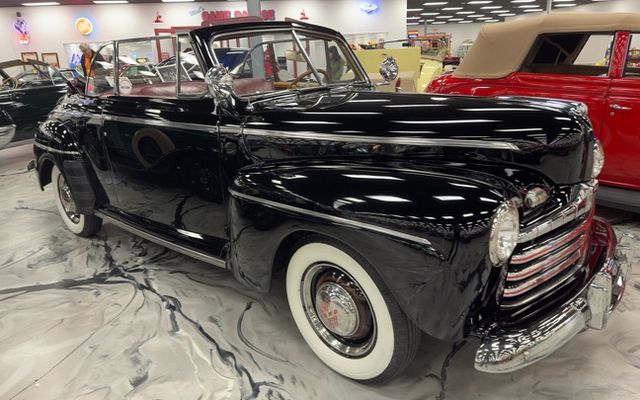
1946 Ford Super De Luxe 2-Door Convertible
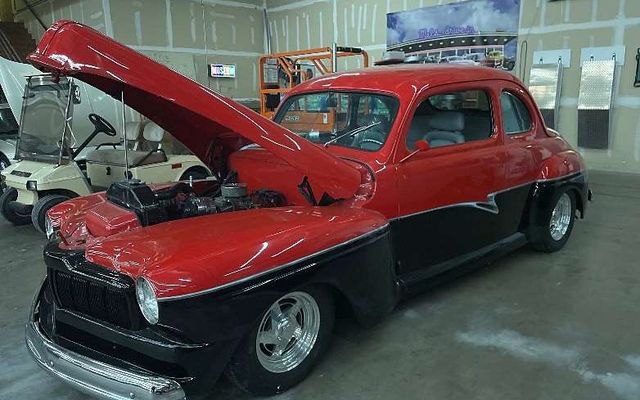
1946 Mercury Eight Coupe Custom
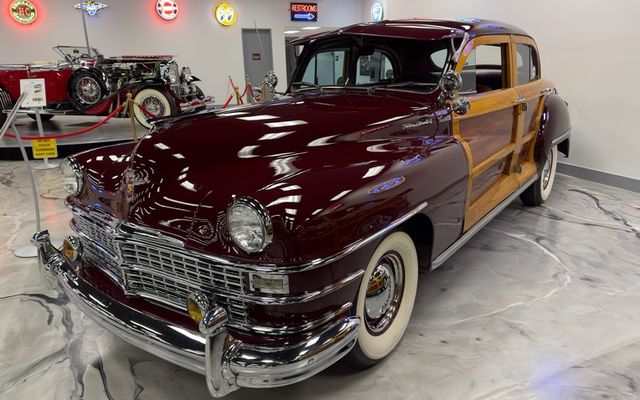
1947 Chrysler Town & Country Sedan
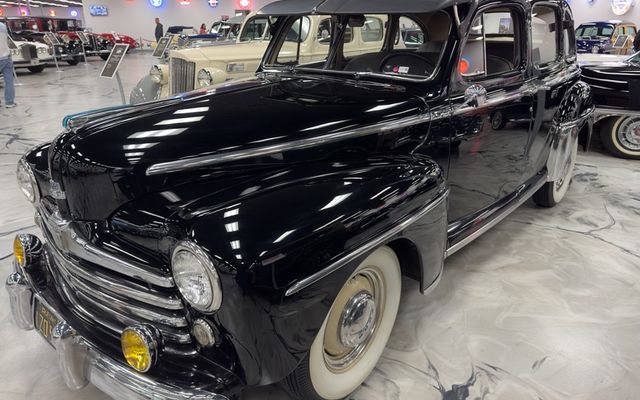
1947 Ford Super Deluxe Fordor
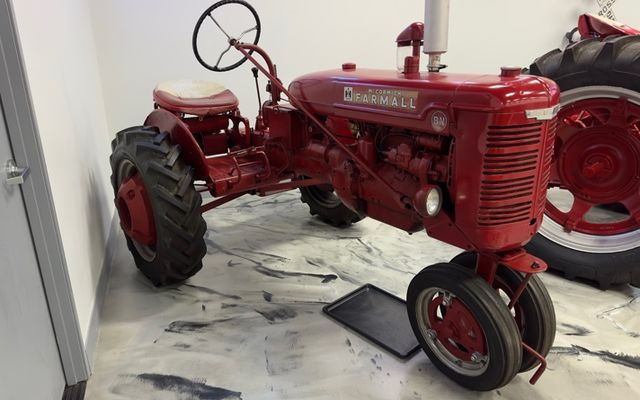
1947 McCormick Farmall BN Culti-Vision Tractor
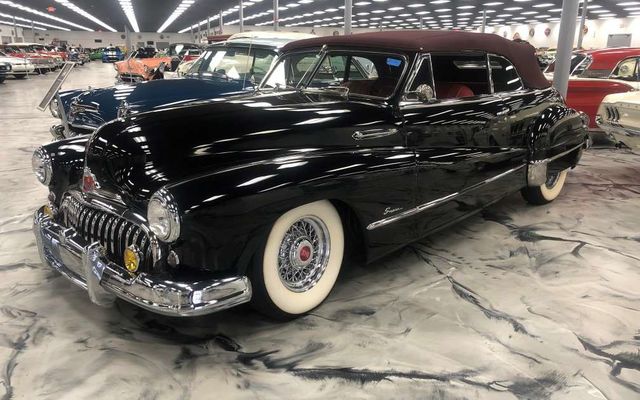
1948 Buick Super Convertible
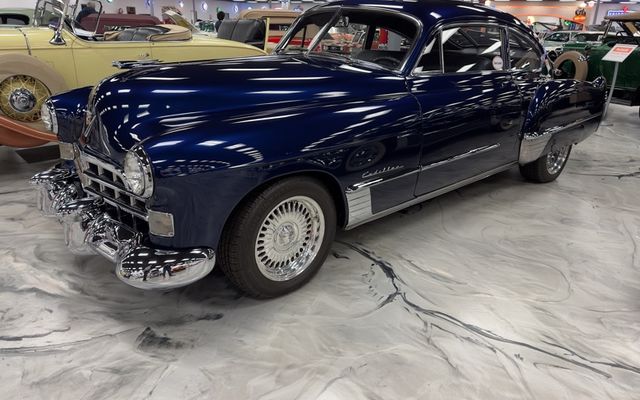
1948 Cadillac Series 62 2-Door Fastback
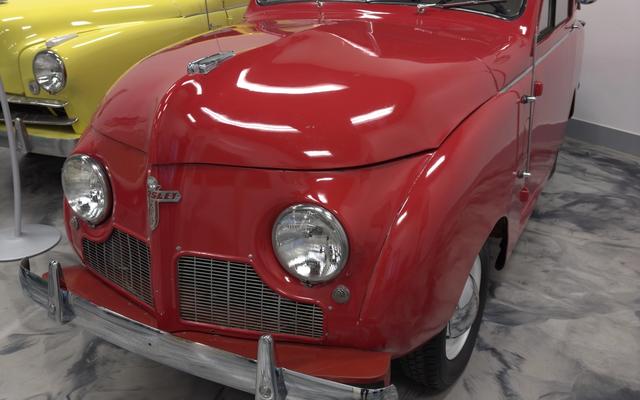
1948 Crosley CC Convertible
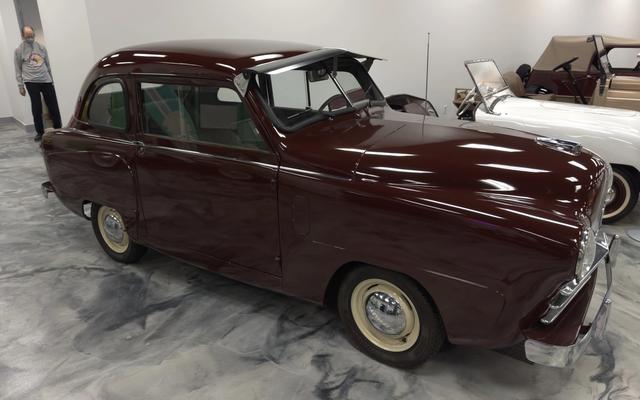
1948 Crosley Super Sedan
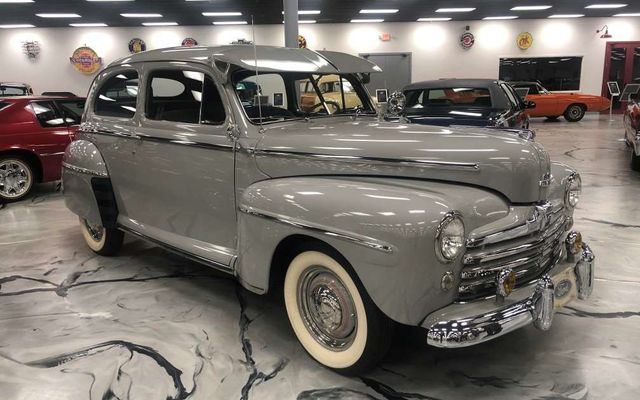
1948 Ford Super Deluxe Sedan